

[ Read this article in PDF format: HERE ]
Leman Copley was born in Connecticut in 1781 and joined a Shaker community near Cleveland in 1820.1 He was an early convert to the Church of Jesus Christ of Latter-day Saints, being baptized in March 1831.2 Joseph Smith’s History records, “At about this time came Leman Copley, one of the sect called Shaking Quakers, and embraced the fulness of the everlasting Gospel.”3 Copley’s conversion was the springboard for Joseph Smith’s May 7, 1831 revelation recorded in D&C 49 which “refuted some of the basic concepts of the Shaker group.”4 Leman Copley was “honest-hearted,” but he still believed that the Shakers were right in some aspects of their faith. Joseph Smith records, “In order to have [a] more perfect understanding on the subject, I inquired of the Lord.”5 After receiving clarification, Leman Copley, Sidney Rigdon, and Parley P. Pratt were commissioned to take the revelation to the Shaker community at Union Village6 and win new converts, but in Pratt’s own words, “they utterly refused to hear or obey the Gospel.”7 John Whitmer records in his history, “The above-named brethren went and proclaimed [the Gospel] according to the revelation given them, but the Shakers hearkened not to their words and received not the Gospel at that time.”8
Copley had originally agreed that the Saints from Colesville, New York, could settle on his property in Thompson, Ohio (just outside of Kirtland), under the law of consecration, but after the failed mission to the Shakers in North Union he changed his mind.9 Copley experienced a faith crisis—having second thoughts about Mormonism, he also had second thoughts about Joseph Smith’s “United Order,” an economic system where the Saints would pool together their resources and land to be used according to individual needs: “The Saints were to make a consecration of whatsoever things they possessed unto the Bishop, and then each man receive from the Bishop a stewardship. Every man was to be equal in his stewardship, according to his family, his circumstances, and his needs.”10 Newel Knight records in his journal, “A man by the name of Copley had a considerable tract of land there [in Thompson] which he offered to let the Saints occupy. Consequently a contract was agreed upon, and we commenced work in good faith. But in a short time Copley broke the engagement.”11 John Whitmer also writes, “At this time [the early part of June] the Church at Thompson, Ohio, was involved in difficulty because of the rebellion of Leman Copley, who would not do as he had previously agreed, which thing confused the whole Church.”12 Because of Copley and others who broke similar agreements (such as Ezra Thayre), the Saints that had just arrived from Colesville were now without a home, and so moved westward to Missouri: “Newel Knight was appointed the leader of this company, which was made up of the Colesville branch, and under his leadership they made the entire journey from Thompson to Missouri.”13
Copley was disfellowshipped in summer 1831 for breaking his promise to the Colesville Saints but was reinstated in October 1832.14 Two years later, in 1834, Joseph Smith took Doctor Philastus Hurlburt to court for threatening his life, and Copley testified against Joseph Smith.15 For this action he was cut off from the Church a second time, but in 1836 he was rebaptized after admitting his error. Joseph Smith’s History records: “He [Leman Copley] confessed that he bore a false testimony against me in that suit, but verily thought, at the time, that he was right, but on calling to mind all the circumstances connected with the things that happened at that time, he was convinced that he was wrong, and humbly confessed it, and asked for my forgiveness, which was readily granted. He also wished to be received into the Church again, by baptism, and was received according to his desire. He gave me his confession in writing.”16 The strange story that follows was allegedly given by Copley during the Hurlbut trial.
Leman Copley and Moroni’s Monkey
The following account was originally published in E.D. Howe’s Mormonism Unvailed, presented as an excerpt of Copley’s testimony in the State vs Hurlburt trial, though I am unable to find any other sources that corroborate the testimony. In a letter from George Gee during his 1841 mission to Pittsburgh, he says that after John E. Page’s discourse on The Book of Mormon, they were approached by a man (who Gee refers to as “the devil”), who brought with him a copy of E.D. Howe’s Mormonism Unvailed, as well as a “pamphlet containing the trial between Br Joseph and Hurlburt at Painsville.” Gee and Page “then left the room while they read Lemon [Leman] Copleys testimony as give[n] at Painesville.” It is unclear if the man (or “devil”) was reading Leman Copley’s testimony as given in E.D. Howe’s book or if he was reading Leman Copley’s testimony as given in the pamphlet, which might corroborate E.D. Howe’s book. No known copies of said pamphlet survive today.17
The result of the 1834 trial against Hurlbut was in Joseph Smith’s favor and the court found that “the said complainant had ground to fear that the said Doctor Ph[ilastus] Hurlbut would wound, beat or kill him, or destroy his property.” Bail was set at $200 and Hurlbut was charged to keep the peace.18 Prior to the trial, Hurlbut had collected a series of affidavits from Joseph Smith’s neighbors in Palmyra with the goal of proving Mormonism a fraud. It was during a fiery anti-Mormon debate that “over 50 witnesses” heard Hulburt say that “he would kill Jo Smith.”19 After the trial, Hurlbut did not publish the affidavits himself, but instead gave them to E.D. Howe who was already working on his book. As Dan Vogel correctly asserts, “The legal entanglement must have dissuaded Hurlbut from publishing the affidavits on his own.”20 In addition to the Hurlbut affidavits, E.D. Howe published an excerpt of Hurlbut’s trial, where Leman Copley told the following story “under oath, before two magistrates of Painesville Township.”21 It is reproduced here in full for the reader:
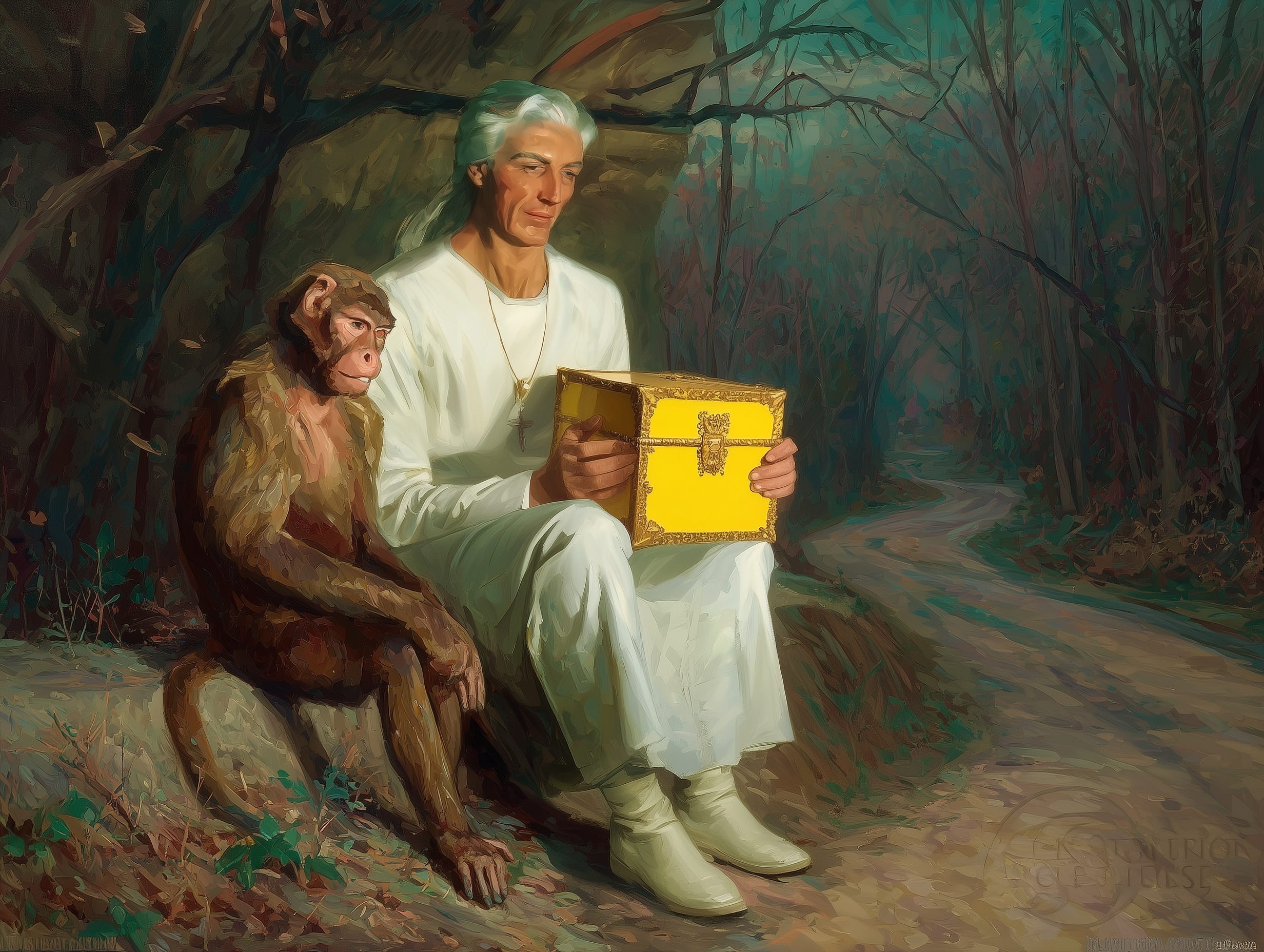
“Mr. Copley testified, that after the Mormon brethren arrived here from the Susquehannah, one of them, by the name of Joseph Knight, related to him a story as having been related to him by Joseph Smith, Jun. which excited some curiosity in his mind, he determined to ask Joseph more particularly about it, on the first opportunity. Not long after it was confirmed to him by Joseph himself, who again related it in the following manner: “After he had finished translating the Book of Mormon, he again buried up the plates in the side of a mountain, by command of the Lord; some time after this, he was going through a piece of woods, on a by-path, when he discovered an old man dressed in ordinary gray apparel, sitting upon a log, having in his hand or near by, a small box. On approaching him, he asked him what he had in his box. To which the old man replied, that he had a MONKEY, and for five coppers he might see it. Joseph answered, that he would not give a cent to see a monkey, for he had seen a hundred of them. He then asked the old man where he was going, who said he was going to Charzee. Joseph then passed on, and not recollecting any such place in that part of the country, began to ponder over the strange interview, and finally asked the Lord the meaning of it. The Lord told him that the man he saw was MORONI, with the plates, and if he had given him the five coppers, he might have got his plates again.” (E.D. Howe, Mormonism Unvailed, p. 388-390)22
While no other story that I’m aware of describes Moroni tricking Joseph Smith with a “monkey in a box,” it’s not entirely out of character with treasure-digging lore, and the Leman Copley story shares some similarities with other Moroni stories—the most similar element being Moroni in disguise as an old man carrying the plates unbeknownst to anyone else until his true identity is revealed, acting as a kind of trickster-spirit. One example that immediately comes to mind is the story David Whitmer told to Edward Stevenson where David, Oliver Cowdery, and Joseph Smith were traveling in a wagon and passed “an aged man about 5 feet 10 [inches tall], heavy Set & on his back an old fashioned Armey knapsack strap[p]ed over his Shoulders & Something Square in it.”23
Just like in the Leman Copley story, Joseph Smith “asked the Lord” about the strange old man, at which point “the Prophet Looked as White as a Sheet & Said that it was one of the Nephites & that he had the Plates.” When they got to the Whitmer house, they were “impressed that the Same Person was under the Shed & again they were informed that it was So.” In the Copley story, Moroni acts like a trickster-spirit with his “monkey in a box,” while in the Whitmer story, Moroni acts like a trickster-spirit hiding under the shed. He doesn’t come out until the next day, when he reveals himself and the gold plates to Mary Whitmer: “The next Morning Davids Mother [Mary Musselman Whitmer] Saw the Person at the Shed and he took the Plates from a Box & Showed them to her.”24 This is a much more familiar story that is retold even as recently as the January 2024 edition of the Liahona, an official Church publication:
“Outside her home, a gray-haired man with a knapsack over his shoulder approached Mary and said, “My name is Moroni. You have become pretty tired with all the extra work you have to do.” Taking the knapsack off his shoulder, Moroni continued, “You have been very faithful and diligent in your labors. It is proper, therefore, that you should receive a witness that your faith may be strengthened.” He then revealed the contents of his knapsack—the gold plates.” (“Becoming a Witness,” Liahona, January 2024 Edition)25
Whether either of these stories truly originate with Joseph Smith is up to the reader. In the case of Leman Copley, while sharing similarities with other stories (like Joseph reburying the plates—a claim that Joseph’s brother, William Smith, also makes26), his “monkey in a box” story has undoubtedly gone through a game of telephone. If it really did originate with Joseph Smith, then it traveled from Joseph Smith to Joseph Knight to Leman Copley to Doctor Hurlbut and finally to E.D. Howe, where it was published in Mormonism Unvailed. That’s five people that the story had to go through, two of which who are explicitly anti-Mormon (Richard L. Anderson points out, Hurlbut’s “own character appears to be worse than the worst he gathered about Joseph Smith.”27), while Leman Copley himself confessed to Smith that he “bore false testimony” against him at the same trial where the story originates. Does that false testimony include the “monkey in a box?” I don’t know that we can arrive at a definitive answer, but the tale is interesting nonetheless. Another interesting story related to Copley is the account of his being possessed or attacked by Satan at the June 1831 Conference in Kirtland—a story that E.D. Howe reports in the same book as Copley’s Moroni story, but fails to identify Copley as one of its characters. If Howe knew, he would have certainly named Copley in his version of events. I will do so in mine.
Leman Copley Possessed by the Devil
Ezra Booth, “the first apostate to write publicly against the new Church,”28 provided several letters for E.D. Howe to publish in his book, Mormonism Unvailed, including a retelling of events that happened in June 1831 at the long-awaited Kirtland Conference. One such story is the demonic possession of Harvey Whitlock, which Booth summarized in the following narrative:
“Another Elder, who had been ordained to the same office as [Lyman] Wight, at the bidding of Smith, stepped upon the floor. Then ensued a scene, of which you can form no adequate conception; and which, I would forbear relating, did not the truth require it. The Elder moved upon the floor, his legs inclining to a bend; one shoulder elevated above the other, upon which the head seemed disposed to recline, his arms partly extended; his hands partly clenched; his mouth partly open, and contracted in the shape of an italic O; his eyes assumed a wild ferocious cast, and his whole appearance presented a frightful object to the view of the beholder. —“Speak, Brother Harvey” said Smith. But Harvey intimated by signs, that his power of articulation was in a state of suspense, and that he was unable to speak. Some conjectured that Harvey was possessed of the devil, but Smith said, “the Lord binds in order to set at liberty.” After different opinions had been given, and there had been much confusion, Smith learnt by the spirit, that Harvey was under a diabolical influence, and that Satan had bound him; and he commanded the unclean spirit to come out of him.” (Mormonism Unvailed, p. 207)29
Although an anti-Mormon source, the stories of the demonic attacks at the June 1831 Conference seem to be accurate and are reproduced extensively by Mormon sources as evidence of Joseph Smith’s power over evil spirits. One detail that Booth leaves out is that after Smith expelled the “man of sin” out of Harvey Whitlock, several other people were attacked, including our now-familiar character, Leman Copley. Philo Dibble was a first-hand witness to the events and records that it was first Hyrum Smith who identified the evil spirit: “Hyrum Smith arose and declared that there was an evil spirit in the room … and stepping to Harvey, commanded the evil spirits to leave him, but the spirits did not obey.”30
According to Levi Hancock, Hyrum said to his brother, “Joseph, that is not of God,” at which point, “Joseph bowed his head, and in a short time got up and commanded Satan to leave Harvey, laying his hands upon his head at the same time. At that very instant an old man said to weigh two hundred and fourteen pounds sitting in the window turned a complete summersault in the house and [landed on] his back across a bench and lay helpless. … The man’s name was Leamon Coply [Leman Copley], formally a Quaker [Shaker].”31 Philo Dibble records the same: “Next thing I saw a man came flying through the window from outside. He was straight as a man’s arm as he sailed into the room over two rows of seats filled with men, and fell on the floor between the seats and was pulled out by the brethren. He trembled all over like a leaf in the wind. He was soon . . . calm and natural. His name was Lemon [Leman] Copley. He weighed over two hundred pounds. This I saw with my own eyes and know it is all true, and bear testimony to it.”32
Besides Harvey Whitlock and Leman Copley, there was evidently a third man attacked by Satan that day. Hancock writes that after “Joseph told Lyman [Wight] to cast Satan out [of Leman Copley] … The evil spirit left him and as quick as lightening Harvey Green fell bound and screamed like a panther. Satan was cast out of him. But immediately entered someone else. This continued all day and the greater part of the night. … After this we … heard Harvey Whitlock say when Hyrum Smith said it was not [of] God, he disdained him in his heart and when the Devil was cast out he was convinced it was Satan that was in him and he knew … it. I also heard Harvey Green say that he could not describe the awful feeling he experienced while in the hands of Satan.”33 Likewise, Dibble reports, “Harvey Green was thrown upon his back on the floor by an unseen power. Some of the brethren wanted to administer to him by laying on of hands, but Joseph forbade it. Harvey looked to me like a man in a fit. He groaned and frothed at the mouth. Finally he got upon his knees and came out of it.”34 The fear of demonic possession gripped the congregation and Joseph Smith warned another member, “Heamon [Heman] Bassett you sit still the Devil wants to sift you…”35 Levi Hancock records that the fear was still in the air the following night and that he and a group of elders encountered Satan in the form of a jackass:
When night came Solomon and I, Wheeler Baldwin and some others started to my father’s, we walked heavily, some said that they felt as if they would be seized by Satan. Others that they felt as though the Devil and his angels were hanging about them. I kept my feelings to myself, until we came to the mill pond of Mr. Fergdsons about a half or a little over the distance we had to go that night. When we had got against the pond which was about fourteen rods across and very deep, I said, “Let us pray.” So we all kneeled down and prayed around a circle as soon as the last one got through about nine o’clock at night and the moon shown brightly. A sudden bray of a jackass was heard about twenty feet behind us. We looked and could see nothing and nothing in the way. It started toward the pond braying all the time. I never had seen one in my life and I know that there was none about there for I was well acquainted there. I heard how they brayed. The most of our company had seen them. This braying continued across the pond and ascended the high hills on the other side until it grew less and less distinct until it got out of hearing.. “There,” said Brother Baldwin. “This proves to me that this work is true, for we all prayed for assistance; the Devil ran away.” We all felt that it must have been Satan, and some said as much. We then started on our way feeling much better and as light as ever we felt. We told it to some but it seemed like an idle tale to them. This took place on the fifth of June 1831. This may appear strange to some but God knows that I lie not. Am ready to meet it before the heavens–that night seized me and I thought he would destroy me.”36
It’s strange stories like this during the Kirtland period, that give credence to the “Entheogenic Origins of Mormonism” Theory, popularized largely by Bryce Blankenagel37, though it had been presented even earlier by Robert Beckstead in 200738, Lamar Peterson in 197539, and originally by Jasper Moss, a medically-trained schoolteacher, who was an eyewitness to many of the strange happenings in Kirtland at the time. Moss suspected that rather than demonic attacks and spiritual manifestations, the Kirtland Saints were under the influence of some kind of hallucinogen in their sacramental wine. He wrote, “We witnessed the administration & became fully satisfied that the wine was medicated & I tried to steal the bottle with the ballanc of wine left & came near doing it & when I told my suspicions & how near I came to getting the wine those performances ceased.”40 On another occasion he said, “I became satisfied that their power was in the wine, so I tried to steal a bottle, and would have succeeded if I had been wearing the cloak I usually wore.”41 Whether Leman Copley was possessed by the devil or was under the influence of hallucinogenic wine, it’s still quite the mental image of a 200-pound man stiff as a board flying through a window over two rows of seated congregants.
Lucy Mack Smith also records this event in her famous Biographical Sketches of Joseph Smith, emphasizing Satan’s power to bind his victims’ tongues and contort their arms, face, and fingers as if in a spasm.42 As a final example, Zebedee Coltrin (who was among those who were visited by Jesus and Heavenly Father in the School of the Prophets after a communion of “warm bread” and “a glass of wine”43), also described this event, adding that after throwing Leman Copley through a window, and being cast out of both Copley and Green, “the spirit” went outside and violently threw a group of men to the ground:
“One man by the name of Leman Copley, standing at the back side of the house was taken by a supernatural power, and thrown into the window. Then Joseph said to Lyman [Wight] “Go and cast the devil out of Leman.” He did so, and the devil entered into a brother by the name of Harvey Green and threw him upon the floor in convulsions. Then Joseph laid hands upon him and rebuked the spirit from him and from the house, upon which the spirit left him, and went outside among a crowd of men standing near the door and made a swath among them several feet wide, throwing them violently to the ground.” (Remembering Joseph, p.181)44
Leman Copley Joins the Brewsterites
Despite having an on-again off-again relationship with the Church, Leman Copley eventually left for good, instead joining James C. Brewster and his fledgling “Church of Christ” in 1849. Brewster was a schismatic figure who had claimed since the age of ten that Moroni had been visiting him with new revelations for the church. In November of 1837, he was disfellowshipped at the age of eleven for “giving heed to revelations said to be translated from the Book of Moroni … and for entering into a written covenant different from the articles and covenants of the Church of Latter-day Saints, and following a vain and delusive spirit.”45 It was even alleged in the Kirtland High Council Meeting that Moses R. Norris ordained Brewster a prophet.46 Brewster claimed that he was indeed ordained a prophet, not by Norris, but by Joseph Smith, Sr., who before taking Brewster and his father on a money-digging adventure, anointed the group’s “mineral rods and seeing stones with consecrated oil” and “prayed over them in the house of the Lord in Kirtland”, after which he “sealed it up on me by the power of the Holy Priesthood … that I should be a Prophet, a Seer, a Revealer, and Translator, and that I should have power given me of God to discover and obtain the treasures which are hid in the earth.”47
After agreeing to cease his prophetic activities Brewster was readmitted to the church, although he had no intention of honoring that commitment as the revelations soon continued. After receiving a series of visions, Brewster began the task of committing his prophecies to paper. In his first vision he saw an angel “who showed him a large round table supporting a vast quantity of books” which were “ancient records that are to be written.” In his second vision, “he saw the lost books of Esdras, the writings of an ancient Israelite prophet.” In his third vision an angel declared to him “that it is the will of the Lord that you should commence and write those books of Esdras.” On December 27, 1838, the now twelve-year-old Brewster, unbeknownst to the church, began translating the records of Esdras through several scribes. This task would take him nearly four years to complete, finally publishing his book in June 1842 at the age of sixteen.48
Shortly before the completion of the book, the teenage prophet’s father, Zephaniah Brewster, began having doubts about the source of the revelations and met with Hyrum Smith, who urged him to take the manuscript to Joseph Smith for clarification. After six days, the boy’s father finally received Joseph’s verdict: “Brewster showed me the Manuscripts. I enquired of the Lord and the Lord told me the book was not true. It was not of him. If God ever called me, or spoke by my mouth, or gave me a revelation, he never gave revelations to that Brewster Boy or any of the Brewster race.”49 Ignoring Joseph Smith’s condemnation, Brewster and his father published the revelations as a pamphlet entitled, “The Words of Righteousness to All Men,” an action which led to their excommunication. John Taylor, then editor of the Times and Seasons and future President of the Church, wrote:
“We have lately seen a pamphlet, written, and published by James C. Brewster; purporting to be one of the lost books of Esdras; and to be written by the gift and power of God. We consider it a perfect humbug, and should not have noticed it, had it not been assiduously circulated, in several branches of the church. This said Brewster is a minor; but has professed for several years to have the gift of seeing and looking through or into a stone; and has thought that he has discovered money hid in the ground in Kirtland, Ohio. His father and some of our weak brethren, who perhaps have had some confidence in the ridiculous stories that are propagated concerning Joseph Smith, about money digging, have assisted him in his foolish plans, for which they were dealt with by the church. They were at that time suspended, and would have been cut off from the church if they had not promised to desist from their ridiculous ways. Since which time the family removed to Springfield, in this state; and contrary to their engagement have been seeing, and writing, and prophecying, &c. for which they have been dealt with by the Springfield church.” (Times and Seasons, December 1, 1842, p. 32)50
In Brewster’s “A Warning to the Latter Day Saints, Generally Called Mormons,” which contains the Ninth Book of Esdras, Esdras prophecies of the fall of Nauvoo, claiming the people of Nauvoo “have been a wicked and rebellious people, … they shall be driven out of the land of their inheritance. As Israel was driven forth by Nebuchanezzer, king of Babylon.”51 Because of the sudden western migration after the death of Joseph Smith (who Brewster claimed was a fallen prophet), many saw the now deserted Nauvoo as a fulfillment of Brewster’s prophecy. On September 29, 1849, James Brewster, Jackson Goodale, and Hazen Aldrich officially formed the First Presidency of the newly established “Church of Christ.” It is around this time that Leman Copley would have been swayed by Brewster’s prophetic claims, joining the new Church which would see membership grow into the “hundreds”52 by the following year.
Brewster had long declared that California would be a refuge for the Saints, as he had received a revelation that the gathering would be “upon the river Bashan [the Rio Colorado], beyond the wilderness of Deluen.” Joseph Smith was aware of this claim as early as 1842 and said: “Brewster may set our for California but he will not get there unless some body shall pick him up by the way [and] feed him &c.”53 On August 5, 1850, the now twenty-four-year-old Brewster departed for California with a ninety-member company, finally fulfilling his mission that was set forth at least eight years earlier when he was sixteen.54 No longer translating only books in visions, Brewster translated Mayan hieroglyphics from a book by John L. Stephens, Indian pictographs he found on rocks as he passed through New Mexico, and even the infamous Kinderhook Plates. Brewster’s translation differed significantly from Joseph Smith’s translation. Brewster claimed that the Kinderhook Plates contained the “History of the Altewanians,” written by “Varamenta, the last of the Altewanians,” whose people were destroyed in war with another nation about 400 A.D.55
The Brewsterite movement was short-lived after arriving in California, and many stayed behind in Kirtland, including Leman Copley. Hazen Aldrich voiced his dissatisfaction of Brewster: “We believe J.C. Brewster has misconstrued the Writings of Esdras to his own liking.”56 In response, Brewster accused Aldrich of usurping church authority.57 After several setbacks and failures as well as infighting between church leaders, membership slowly dwindled. Dan Vogel summarized James Brewster in the following way: “Young Brewster’s prophetic model was Joseph Smith, Jr., and in most important ways he attempted to emulate the Mormon leader’s career. But Brewster wished to succeed where he believed the Mormon prophet had failed, in the establishment of a utopian society.”58 By Brewster’s own metric, Brewster failed. The Reorganized Church’s official history states that Brewster was last heard “lecturing in California in advocacy of the system known as spiritualism,”59 either abandoning his failed prophetic career altogether or synthesizing Mormonism with Spiritualism as Amasa Lyman, The Godbeites, and many others did at the time, including David Hyrum Smith (Joseph Smith’s youngest son) who traveled to Utah in search of Laban’s “Urim and Thummim” or “peep-stone” having his horoscope cast for this purpose to see what his “lucky stars” had to say on the matter.60 It’s unclear how Leman Copley responded to the now-failed Brewsterite Church, but it’s a fascinating tale nonetheless.
E.D. Howe, Mormonism Unvailed, p. 388
Black, Susan Easton. “Leman Copley.” In Restoration Voices: Volume 1: People of the Doctrine and Covenants, Vol. 1. Springville, UT: Book of Mormon Central, 2021.
History of the Church, vol. 1, p. 167
D&C 49: Introduction
History of the Church, vol. 1 p. 167
Dan Vogel, Early Mormon Documents, Vol. 1
The Autobiography of Parley P. Pratt, p. 49
Joseph Smith Papers, Histories vol. 2, p. 38. Also – An Early Latter Day Saint History: The Book of John Whitmer, p. 61. Also – From Historian to Dissident: The Book of John Whitmer, p. 57
E.D. Howe, Mormonism Unvailed, p. 190
History of the Church, vol. 1, p. 180
The Rise of the Latter-Day Saints: The Journals and Histories of Newel Knight, p. 33
Joseph Smith Papers, Journal Vol. 2, p. 41
History of the Church, vol. 1, p. 181
Black, Susan Easton. “Leman Copley.” In Restoration Voices: Volume 1: People of the Doctrine and Covenants, Vol. 1. Springville, UT: Book of Mormon Central, 2021.
Mormonism Unvailed, p. 388
History of the Church, vol. 2, p. 433
Joseph Smith Papers, Documents Vol. 9, p. 53
Ohio v. Dr. P. Hurlbut April 9. Full note on page xxi of Mormonism Unvailed
Dowen affidavit, Jan. 2, 1885. Full note on page xx of Mormonism Unvailed
E.D. Howe, Mormonism Unvailed, p. xxi
E.D. Howe Mormonism Unvailed, p. 388
E.D. Howe, Mormonism Unvailed, p. 388-390
Dan Vogel, Early Mormon Documents, Vol. 5, p. 30
Dan Vogel, Early Mormon Documents, Vol. 5, p. 31
“Becoming a Witness,” Liahona, January 2024 Edition
Mormonism Unvailed p. 389: “William Smith said his brother was directed to bury the plates in the same manner he had found them.”
BYU Studies 24:4
Dennis Rowley, “The Ezra Booth Letters”, Dialogue: A Journal of Mormon Thought
E.D. Howe, Mormonism Unvailed, p. 207
Philo Dibble, “Recollections of the Prophet Joseph Smith,” in Juvenile Instructor, May 15, 1892, 303.
Levi and Mosiah Hancock Journals Excerpts, p. 46. Also: Levi Ward Hancock and Mosiah Lyman Hancock Journals by C. Weed, p. 56
Philo Dibble, “Recollections of the Prophet Joseph Smith,” in Juvenile Instructor, May 15, 1892, 303.
Levi and Mosiah Hancock Journals Excerpts, p. 46-47. Also: Levi Ward Hancock and Mosiah Lyman Hancock Journals by C. Weed, p. 57
Philo Dibble, “Recollections of the Prophet Joseph Smith,” in Juvenile Instructor, May 15, 1892, 303.
Levi and Mosiah Hancock Journals Excerpts, p. 46. Also: Levi Ward Hancock and Mosiah Lyman Hancock Journals by C. Weed, p. 56
Levi and Mosiah Hancock Journals Excerpts, p. 47-48. Also: Levi Ward Hancock and Mosiah Lyman Hancock Journals by C. Weed, p. 57-58
Robert Beckstead, Bryce Blankenagel, Cody Noconi, and Michael Winkelman published a paper titled “The entheogenic origins of Mormonism: A working hypothesis” which documents the theory in depth.
Robert Beckstead gave a presentation on his research paper titled “Restoration and the Sacred Mushroom” at Sunstone in 2007.
Lamar Peterson published his book titled “Hearts Made Glad” in 1975 exploring the use of alcohol in the early church, despite the later Word of Wisdom health code.
Dec. 17, 1878 Jasper Jesse Moss Letter
The Christian Stander - Cincinnati, January 26, 1938
Lucy’s Book, p. 507
ULC Press – Salt Lake School of the Prophets Minute Book 1883, p. 38. Also: Pioneer Publishing – Salt Lake School of the Prophets Minute Book 1883, p. 54-55
Remembering Joseph, p. 181
History of the Church 2:525
History of the Church 2:526
James C. Brewster, “Very Important! To the Mormon Money Diggers” p. 3
Differing Visions, Dan Vogel, p. 121-122
History of the Church 5:214
Times and Seasons, December 1, 1842, p. 32
James Brewster, “A Warning to the Latter Day Saints, Generally Called Mormons. An Abridgement of the Ninth Book of Esdras, p. 1-2, 5, 8
Dale L. Morgan, a Bibliography of the Churches of the Dispersion, p. 113
History of the Church 5:214
Differing Visions, p. 132
Differing Visions, p. 131
Differing Visions, p. 132
Divergent Paths of the Restoration, p. 56
Differing Visions, p. 120
History of the Reorganized Church 3:73
From Mission to Madness, p. 210